Maga is calling for naturalised citizens to be denied the same rights as US-born ones
Wednesday, February 25, 2026

“I Don’t Want to Be Here Anymore”: They Tried to Self-Deport, Then Got Stranded in Trump’s America
"This story was originally published by ProPublica."
https://www.propublica.org/article/trump-self-deportation-cbp-home-app
ProPublica is a nonprofit newsroom that investigates abuses of power. Sign up for Dispatches, a newsletter that spotlights wrongdoing around the country, to receive our stories in your inbox every week.
by Melissa Sanchez and Mariam Elba
Reporting Highlights
Stoking Fear: The Trump administration’s immigration crackdown has left many immigrants afraid of being detained and deported. Some have opted to leave the U.S. on their own.
Broken Promises: The administration has promoted an app to help immigrants leave the U.S. and promised to pay for flights and give them $1,000. Some haven’t gotten what was promised.
Unwanted: Many immigrants, particularly those from Venezuela, say they feel stuck. They’re unwanted in the U.S. and afraid to return to their homeland.
These highlights were written by the reporters and editors who worked on this story.
She desperately wanted to get out of the country.
It was mid-May and Pérez, a Venezuelan mother of two, couldn’t survive on her own in Chicago anymore. She’d been relying on charity for food and shelter ever since her partner had been detained by immigration authorities after a traffic stop earlier in the year.
Pérez, 25, thought it’d be safer to return to Venezuela with her children than to stay in the U.S. Her request for asylum was still open and she had a permit to work legally, but so did a lot of other Venezuelans getting picked up on the streets and taken into custody. Authorities were detaining immigrants regardless of whether they’d followed the rules.
She had also seen how President Donald Trump singled out her countrymen, calling them gang members and terrorists, even sending hundreds to a foreign prison. She was terrified of getting detained, deported and, worst of all, separated from her young daughter and son. They were the reason the family had come to the U.S.
Then she heard about Trump’s offer of a safe and dignified way out.
“We are making it as easy as possible for illegal aliens to leave America,” the president said in a video on social media in May announcing the launch of Project Homecoming.
He spoke about a phone app where “illegals can book a free flight to any foreign country.” And he dangled other incentives: Eligible immigrants wouldn’t be barred from returning legally to the U.S. someday, and they’d even get a $1,000 “exit bonus.” Believing the president’s words, Pérez downloaded the CBP Home app and registered to return to Venezuela with her children.
Months passed. Her partner was deported. In July, Pérez said, she got a call from someone in the CBP Home program telling her she’d be on a flight out of the country in mid-August. She began packing.
But as the departure date neared and the plane tickets hadn’t arrived, Pérez got nervous. Again and again, she called the toll-free number she’d been given. Finally, somebody called back to say there might be a delay obtaining the documents she’d need to travel to Venezuela.
Then there was silence. No further information, no plane tickets. Pérez registered on the app again in August, then a third time in September, as immigration arrests ramped up in Chicago.
Today, Pérez feels trapped in a country that doesn’t want her. She’s afraid of leaving her apartment, afraid that she will be detained and that her children will be taken away from her. “I feel so scared, always looking around in every direction,” she said. “I was trying to leave voluntarily, like the president said.”
The Trump administration’s immigration crackdown is having the intended effect of terrifying people into trying to leave. There have been some 25,000 departures of immigrants from all countries via CBP Home, according to U.S. Department of Homeland Security data obtained by ProPublica.
The data indicates that of those 25,000 people, a little more than half of them returned home with DHS assistance; nearly all the others who left the U.S. ended up returning on their own.
And it’s not just CBP Home. Applications for voluntary departures — an alternative to deportation granted to some immigrants who leave at their own expense — have skyrocketed to levels not seen since at least 2000, reaching more than 34,000 since Trump’s second administration began, immigration court data shows. (The number is higher than in years past, but nowhere near the number of immigrants the administration has deported this year.)
But for many recent arrivals from Venezuela — arguably the community most targeted by the Trump administration, and whose country is now bracing for the possibility of a U.S. invasion — leaving has not been as simple as the president has made it sound.
ProPublica spoke with more than a dozen Venezuelans who said they wanted to take the U.S. government’s offer of a safe and easy return. They signed up months ago on the CBP Home app and were given departure dates. But after those dates came and went, these immigrants said they feel betrayed by what the president told them.
Part of the problem is tied to the lack of diplomatic relations between Washington and Caracas. There are no consular services for Venezuelans in the U.S. Many of the hundreds of thousands of Venezuelans who migrated to the U.S. in recent years seeking asylum or other humanitarian relief entered without valid passports, as Pérez did. But to get on a plane for Venezuela, they’re being told they’ll need a special travel document known as a “salvoconducto,” or “safe passage,” from their government.
And relations between the two countries are getting worse. The Trump administration has pushed for regime change in Venezuela, sent warships to the Caribbean and, in recent weeks, blew up four Venezuelan boats it claimed were transporting drugs to the U.S. Bracing for an invasion, Venezuelan President Nicolás Maduro has said he’s ready to declare a state of emergency to protect his country, which could make it harder for Venezuelans abroad to return home.
The Venezuelans who want to leave the U.S. described how CBP Home representatives told them that their lack of passports wouldn’t be a problem and that the U.S. government would help them obtain the travel documents they needed. Now they are being told that they’re on their own — if they get any response at all.
The Trump administration was aware of the potential challenges from the start. In his May proclamation, the president directed the State and Homeland Security departments to “take all appropriate actions to enable the rapid departure of illegal aliens from the United States who currently lack a valid travel document from their countries of citizenship or nationality.”
In a statement, a DHS spokesperson said the agency is working with the State Department “to acquire travel documents for those who lack safe passage. So far thousands of Venezuelans have already self-departed using CBP Home.” The State Department referred questions to DHS.
The internal DHS records obtained by ProPublica show nearly 3,700 departures of Venezuelans via CBP Home through late September. It’s unclear how many Venezuelans have applied. The DHS spokesperson said the agency could not confirm the numbers and would not say whether the program is meeting projections. (A congressional committee has directed DHS to include information about CBP Home departures in monthly reports the agency previously published, but has not published in this administration.)
An estimated 10,200 Venezuelans were deported between February and early October, according to deportation flight data tracked by the nonprofit Human Rights First’s ICE Flight Monitor.
Many of the Venezuelans interviewed by ProPublica are mothers of young children who say they decided to take the president’s offer after their work permits expired, their temporary protected status was canceled or their spouses were deported. Few are willing to return by land because of the dangers posed by cartel violence and kidnappings in Mexico — dangers many of them experienced when they migrated here.
Nearly all of them, like Pérez, asked not to be identified by their full names because they’re afraid of bringing unwanted attention to themselves and of the potential consequences of such attention. Interviews with Venezuelan immigrants were conducted in Spanish.
Before their departure dates came and went, they had made preparations to leave — turning over the keys to their apartments, pulling their children from school, shipping their belongings to Venezuela. And they have sunk deeper into poverty as the weeks and months pass.
Pérez applied for her family to return to Venezuela through the CBP Home app months ago but has been stuck in limbo in Chicago without a clear path forward. Jamie Kelter Davis for ProPublica
In Los Angeles, a family of four slept in their tiny Toyota Echo for weeks to save on rent as they waited for their departure date. They sold the car and other belongings to pay for bus tickets back the way they’d come. Nearly two months after their return to Venezuela, they said they’re still waiting for the exit bonuses they’d hoped would help them start over.
In Youngstown, Pennsylvania, a mother of two said she didn’t enroll her 8-year-old son in school this fall because she assumed they would be gone by now. She recently moved into a friend’s apartment in New York City and plans to turn herself in to immigration authorities and ask to be deported.
“I don’t want to be here anymore,” the woman said, between sobs. “What am I supposed to do?”
Several immigration attorneys and advocates told ProPublica that they don’t trust the CBP Home app or the Trump administration’s promises to help immigrants self-deport. The National Immigration Law Center recently published a guide explaining some of the potential risks of using the app, such as leaving the country without closing an immigration court case and becoming ineligible for a future visa. Some lawyers said they discourage clients from using the app at all.
Ruben Garcia, director of Annunciation House, a nonprofit in El Paso that supports migrants and refugees, said in the current climate, he understands why some people might consider the administration’s offer to leave. But, he said, the offer has to be backed by action.
“If you’re going to say you’re going to do this,” Garcia added, “then you damn well better make sure that it’s truthful and that it works.”
Emily, a Venezuelan immigrant in Columbus, Ohio, holds her phone showing an email from the CBP Home program. Maddie McGarvey for ProPublica
CBP Home replaced an earlier app that the Biden administration had promoted to try to bring order to the soaring numbers of migrants attempting to enter the country. Pérez and other asylum-seekers used that earlier version, CBP One, to make appointments to approach the border. Trump, who campaigned on the promise of mass deportations, ended that option on his first day back in the White House.
In March, he reintroduced the app with the new name and function, allowing immigrants to alert the government of their intention to self-deport. It was part of a $200 million advertising blitz meant to encourage immigrants to “Stay Out and Leave Now.” Two months later, Trump unveiled Project Homecoming and the added incentives of free flights and exit payments. The administration moved State Department funds meant to aid refugees resettling in the U.S. to DHS to help pay for the flights and stipends, according to federal records and news reports.
DHS officials have mentioned the app in dozens of press releases about policy changes and enforcement operations. For example, in the September announcement that DHS was ending temporary protected status for Venezuelans, officials also encouraged Venezuelans to leave via CBP Home. And immigrants who show up for their hearings at immigration court see posters taped on the walls about the benefits they could get if they “self-deport using CBP Home instead of being deported by ICE.”
Emily and Deybis downloaded the app in June, when it seemed as if their life in the U.S. was collapsing. They said they used the earlier CBP One app to approach the border with their two children in January 2024 and were allowed into the country with protections that were supposed to last two years. They settled in Dallas, applied for asylum and got work permits; Deybis found a job in a hotel laundry and Emily at a Chick-fil-A. Then, this spring, the Trump administration ended protections for immigrants like them and canceled their work permits.
They lost their jobs and could no longer afford their rent. On the app’s sky-blue home screen, they saw a drawing of a smiling man and woman holding hands with a child. “Let us help you easily leave the country,” another screen told them in Spanish. They agreed to share their phone’s geolocation, entered personal information and uploaded selfies.
They received an automated email from “Project Homecoming Support” explaining that they would be contacted soon by someone from a toll-free number who would help coordinate their travel. Within weeks, they got a call from an operator at that number who said she worked on behalf of DHS.
Emily said she made clear the family didn’t have Venezuelan passports but was told that wouldn’t be a problem; the U.S. government would procure any necessary documents for them. They said the operator gave them an Aug. 1 departure date and told them to expect their plane tickets by email.
Emily and Deybis sold their car and moved with their children to Columbus, Ohio, where Deybis’ nephew let them stay in his unfinished basement apartment until their departure. The plane tickets never came.
Then the nephew was detained in a traffic stop and deported. Panicked, Emily and Deybis said they called the toll-free number again and again, leaving messages that went unanswered. Emily submitted a new application and sent more emails.
In mid-September, they got an email from the “CBP Home team” telling them to contact the Venezuelan embassy in Mexico to get travel documents on their own.
“We are working very hard on your case,” the email assured.
When they called the embassy, though, the number was busy. They found travel agencies that offer to procure travel documents at a cost but said they were told the Venezuelan government requires an arrival date and proof that plane tickets have been purchased. Emily and Deybis can’t afford them.
“Thank you so much for your patience and we understand your frustration,” they heard back in another email. “Wait for new instructions from DHS.”
As they wait, they worry about how they’ll survive when winter comes. Most days, Deybis visits local food pantries and looks for discarded items in alleys and on street corners that they can resell. A few weeks ago, they sold their daughter’s bed to help pay the rent.
“We’d rather be in Venezuela with our family than suffer here,” he said.
Emily and Deybis share a basement apartment in Columbus, Ohio with their two children. They’re unable to work and have resorted to selling the few possessions they have to feed the family. Maddie McGarvey for ProPublica
Pérez said her daughter was the family’s main motivation to come; the girl had been born with a heart defect and needed surgery they could not find in Venezuela, where hospitals operate through power outages and have limited capacity for advanced surgeries, not to mention supplies.
“We didn’t come for the American dream, or for a house, or for some life of luxury,” said Pérez. “What we wanted is for our daughter to live.”
She and her partner made the trek to the U.S. in 2023, with her daughter, then 6, and their 4-year-old son. Pérez thought they did it “the right away” by waiting in Mexico for weeks until they got an appointment to approach the border via CBP One. After they were processed, the family headed to Chicago, a city they had heard was a sanctuary for immigrants. At first they took shelter inside a police station, as hundreds of new immigrant families were doing at the time. Pérez said medical workers who visited the station learned about her daughter’s condition and connected the family to a hospital charity care program. The following spring, the frail little girl with dark brown eyes got the operation she needed.
In late 2024, the family moved to South Florida, where Pérez’s partner found work rebuilding homes damaged by hurricanes. Then in February, he was arrested for driving without a license or registration. He spent about two months in jail before he was transferred into immigration custody.
Pérez didn’t feel safe in Florida anymore. She returned to Chicago with her children.
But as the months pass without an answer from the CBP Home program, Chicago doesn’t feel safe, either. This fall, the Trump administration zeroed in on the city for immigration enforcement, sending in the U.S. Border Patrol. Pérez recently downloaded another app that tells her whether there’ve been sightings of federal immigration agents nearby, and she watches videos of other immigrants getting arrested. One day in September, a federal agent shot and killed an immigrant in a nearby suburb. Pérez wonders if she might die, too.
On a sunny September afternoon, Pérez peered down the street outside her children’s school, scanning for suspicious vehicles. Her daughter, who is now 8, bounded down the steps first, wearing a pink bow and a broad smile. Her son, now 6, in a Spiderman shirt and a blue cast from a playground accident, appeared next.
They share their mother’s anxiety. On their walk home, Pérez’s daughter leaned over her brother and chided him for speaking Spanish in public. The girl said her teacher had warned her that federal agents might be listening.
It reminded Perez that she now needs to leave the U.S. for the same reason she came: her children. She plans to register yet again on the CBP Home app.
Private Prison Exec Calls Mass Deportation Plans ‘Unprecedented Opportunity’
https://theappeal.org/geo-group-earnings-mass-deportations/
GEO Group Chairman George Zoley said the company stands to gain up to $1 billion in additional revenue from detaining and surveilling undocumented immigrants.
15 Myths About Immigration Debunked
https://www.carnegie.org/our-work/article/15-myths-about-immigration-debunked/
Alex Nowrasteh of the Cato Institute offers nonpartisan facts in response to common myths about immigration
What are the common arguments against immigration, and why are they wrong? The Cato Institute’s Alex Nowrasteh, drawing on years of research and debate, counters 15 common myths against immigration with nonpartisan facts in the report The Most Common Arguments Against Immigration and Why They’re Wrong. The Corporation supports the Cato Institute’s immigration program where Nowrasteh is director of immigration studies and the Herbert A. Stiefel Center for Trade Policy Studies.
MYTH #1: “Immigrants will take American jobs, lower wages, and especially hurt the poor.”
FACT: Immigrants don’t take American jobs, lower wages, or push the poor out of the labor market.
MYTH #2: “It is easy to immigrate here legally. Why don’t illegal immigrants just get in line?”
FACT: It’s very difficult to immigrate legally to the United States. Immigration law is second only to the income tax code in legal complexity.
MYTH #3: “Immigrants abuse the welfare state.”
FACT: Immigrants use significantly less welfare than native-born Americans.
MYTH #4: “Immigrants increase the budget deficit and government debt.”
FACT: Immigrants in the United States have about a net zero effect on government budgets — they pay about as much in taxes as they consume in benefits.
MYTH #5: “Immigrants increase economic inequality.”
FACT: Maybe. The evidence on how immigration affects economic inequality in the United States is mixed — some research finds relatively small effects, and some finds substantial ones. The standard of living is much more important than is the income distribution.
MYTH #6: “Today’s immigrants don’t assimilate as immigrants from previous eras did.”
FACT: Immigrants to the United States — including Mexicans — are assimilating as well as or better than immigrant groups from Europe over a hundred years ago.
MYTH #7: “Immigrants are a major source of crime.”
FACT: Immigrants, including illegal immigrants, are less likely to be incarcerated in prisons, convicted of crimes, or arrested than native-born Americans.
MYTH #8: “Immigrants pose a unique risk today because of terrorism.”
FACT: The annual chance of being murdered in a terrorist attack committed by a foreign-born person on U.S. soil from 1975 through the end of 2017 was about 1 in 3.8 million per year.
MYTH #9: “The United States has the most open immigration policy in the world.”
FACT: The annual inflow of immigrants to the United States, as a percentage of our population, is below that of most other rich countries in the Organization for Economic Cooperation and Development.
MYTH #10: “Amnesty or a failure to enforce our immigration laws will destroy the Rule of Law in the United States.”
FACT: America’s current immigration laws violate every principal component of the Rule of Law. Enforcing laws that are inherently capricious and that are contrary to our traditions is inconsistent with a stable Rule of Law.
MYTH #11: “Illegal immigration or expanding legal immigration will destroy American national sovereignty.”
FACT: Different immigration policies do not reduce the U.S. government’s ability to defend American sovereignty.
MYTH #12: “Immigrants won’t vote for the Republican Party — look at what happened to California.”
FACT: Republican immigration policies pushed immigrants away, not the other way around.
MYTH #13: “Immigrants bring with them bad cultures, ideas, or other factors that will undermine and destroy our economic and political institutions. The resultant weakening in economic growth means that immigrants will destroy more wealth than they will create over the long run.”
FACT: There is no evidence that immigrants weaken or undermine American economic, political, or cultural institutions.
MYTH #14: “The brain drain of smart immigrants to the United States impoverishes other countries.”
FACT: The flow of skilled workers to rich nations increases the incomes of people in the destination country, enriches the immigrants, and helps (or at least does not hurt) those left behind.
MYTH #15: “Immigrants will increase crowding, harm the environment, and [insert misanthropic statement here].”
FACT: People, including immigrants, are an economic and environmental blessing and not a curse.
In the report, Nowrasteh considers the root of the arguments presented, as well as the ways they are misunderstood and miscontextualized. To learn more, read the full report The Most Common Arguments Against Immigration and Why They’re Wrong.
TIKTOK ISN’T ANTI-ISRAEL: IT’S HIRED UNIT 8200 AGENTS TO RUN ITS AFFAIRS
TikTok isn’t anti-Israel: It’s Hired Unit 8200 Agents to Run its Affairs
TikTok has been under intense pressure as of late from U.S. officials, who accuse the video platform of being a hub of anti-Israel hatred. “TikTok is a tool China uses to spread propaganda to Americans. Now it’s being used to downplay Hamas terrorism,” wrote Republican Senator Marco Rubio. “TikTok needs to be shut down. Now,” he added.
Nikki Haley, another top Republican, claimed that every 30 minutes spent on the app makes Americans “17% more antisemitic [and] more pro-Hamas.”
The platform’s future remains uncertain, as President Biden approved a law that could see it blocked in the U.S. Incoming president, Donald Trump, however, has intimated that he does not favor an outright ban.
This investigation is part of a series on TikTok. A previous investigation found that, far from being a Chinese spying tool, the platform has actually hired a plethora of U.S. national security state officials to run its internal affairs. A second article explored TikTok’s fraternization with the U.S. State Department.
Spies In Our Midst
Likewise, for all the discussion that it is a hotbed of anti-Semitic prejudice turning the youth against Israel, this MintPress News investigation has found that TikTok has hired a myriad of former spooks from Israeli spying agency, Unit 8200, the Israeli Defense Forces’ (IDF) most controversial organization. Responsible for covert operations, spying, surveillance and cyber warfare, Unit 8200 has created a vast digital surveillance dragnet for Palestinians, uses AI-generated kill lists to target Gazans, and pioneered worldwide spying software used against politicians, activists, journalists and world leaders. It was widely reported to be behind the recent Lebanese pager attack that injured thousands of civilians.
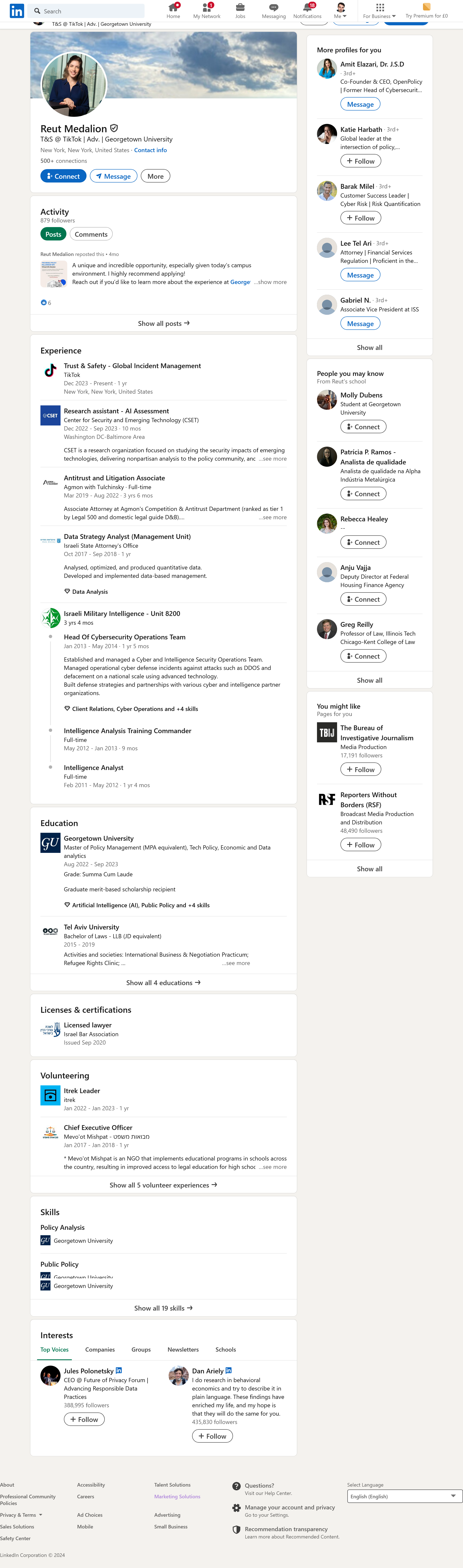
Reut Medalion, for example, enjoyed a long career at Unit 8200, serving as an intelligence commander and later becoming head of its cybersecurity operations team. In the wake of Israel’s attack on Gaza, she moved to New York City to work as a global incident manager for TikTok’s trust and safety division. Considering the events going on in the world at the time, it is fair to wonder with what sorts of “global incidents” is she helping TikTok.
Asaf Hochman is also a longtime veteran of Unit 8200, spending far longer than standard Israeli military service requires. In 2021, TikTok hired him as their global head of product strategy and operations. Hochman now works at Meta, the parent company of Facebook, Instagram, and WhatsApp.
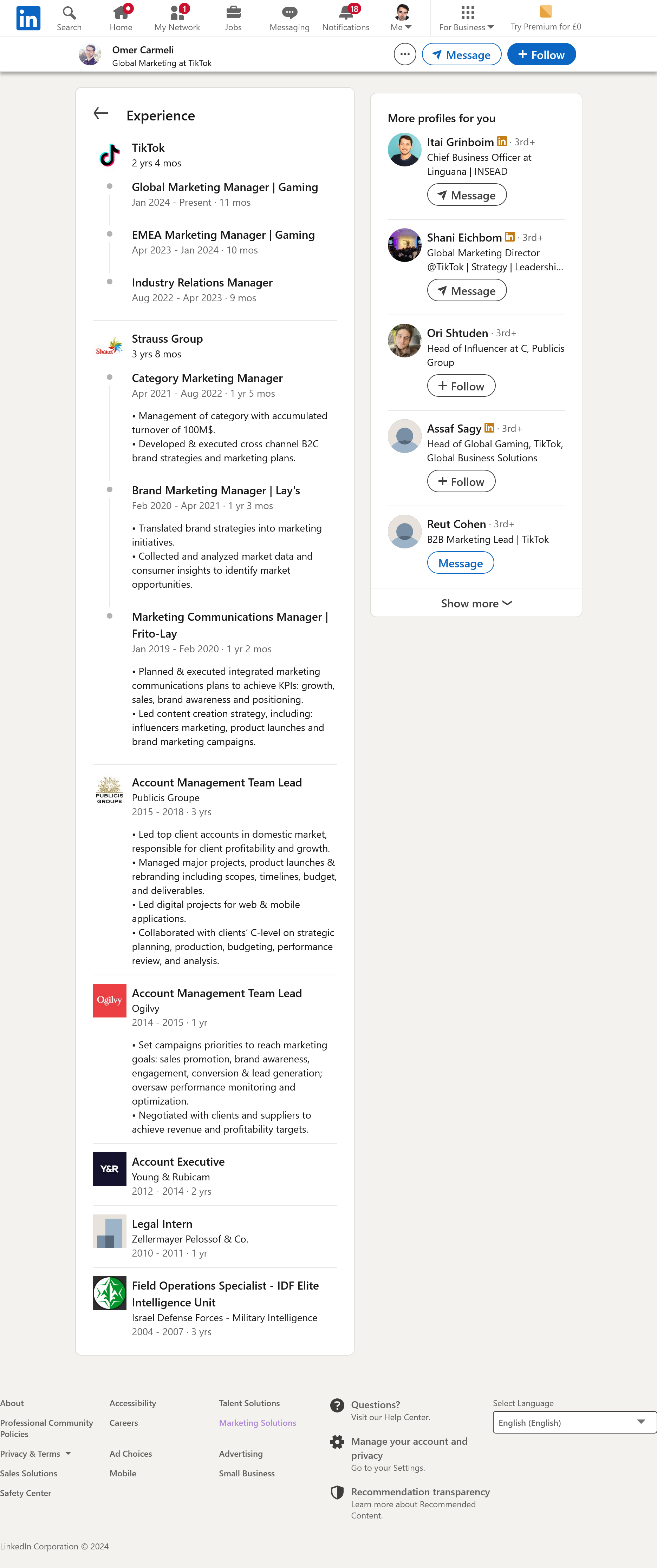
Omer Carmeli is currently TikTok’s global marketing manager. But this was not always so. Between 2004 and 2007, he was a field operations specialist with Unit 8200, serving throughout Israel’s 2006 War on Lebanon and Operation Summer Rains, the IDF’s four-month attack on Gaza.
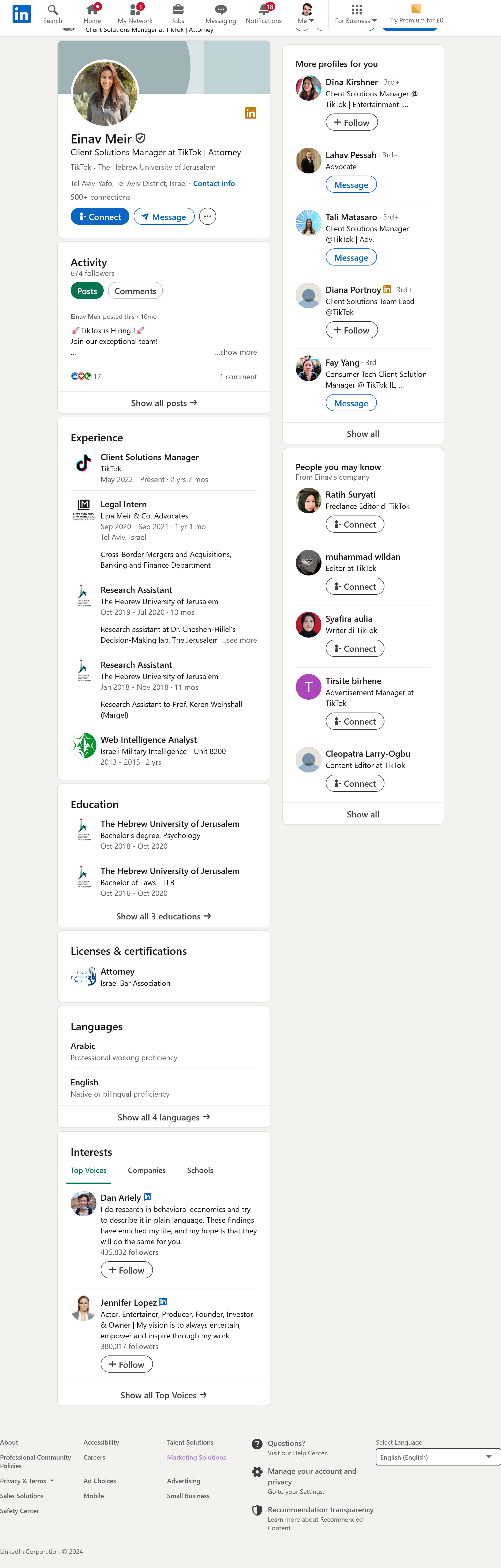
Einav Meir was an intelligence analyst with Unit 8200 until 2015. She is now a client solutions manager at TikTok.
Omri Hollander, a client solutions lead with the global video platform, followed the same Unit 8200 intelligence analyst to the TikTok pipeline.
Diana Shpakovsky Magen, meanwhile, was once both an intelligence analyst and training commander at Unit 8200. After she left the military, she worked in tech and is now an account manager for TikTok. Shpakovsky Magen’s dates of service align with Operation Cast Lead, the 2008-2009 campaign against Gaza widely seen as one of the worst war crimes of the 21st century (until Israel’s current campaign vastly surpassed it). What her role as a commander was during the campaign is unknown.
An Elite Israeli Spying Unit
Why should it be of concern that TikTok is hiring so many former Israeli intelligence agents? Firstly, Unit 8200 is the centerpiece of Israel’s repressive and hi-tech state apparatus. It is responsible for pioneering the technology that has allowed it to create both a gigantic digital dragnet to surveil, harass and intimidate the Palestinian population and for creating spying tools aimed at penetrating and compromising foreign governments and individuals.
Unit 8200 agents use facial recognition technology to track Palestinians’ every move and listen to their phone conversations, the information they glean being used as material for blackmail. One Unit 8200 whistleblower revealed that, as part of their training, they were assigned to memorize different Arabic words for “gay” so that they could listen out for them in conversations.
The unit is also behind Project Lavender, a giant, A.I.-generated kill list of tens of thousands of Gazans that the Israeli military uses to target the strip’s civilian population. Earlier this year, it planned and carried out an attack on Lebanon, exploding thousands of pagers at the same time, injuring thousands of civilians. The event was widely described, even by former director of the CIA, Leon Panetta, as an act of terrorism.
Former Unit 8200 agents, working hand-in-hand with the Israeli national security state, have gone on to create some of the world’s most notorious malware and hacking products. A case in point is the Pegasus software used to spy on more than 50,000 journalists, politicians, diplomats, business leaders and human rights defenders. This included heads of state, such as President Emmanuel Macron of France, Prime Minister Imran Khan of Pakistan, and President Barham Salih of Iraq.
Known purchasers of Pegasus include the Central Intelligence Agency and the government of Saudi Arabia, who used Pegasus to spy on Washington Post journalist Jamal Khashoggi before he was assassinated by Saudi agents in Türkiye. All sales of Pegasus had to be approved by the Israeli government, who reportedly had access to the data Pegasus’ foreign customers were accruing.
Former agents of Unit 8200 doubtless possess highly desirable tech skills and knowledge. However, given the organization’s past and present actions, it is highly questionable that global tech companies hire them, especially in roles that give them access to sensitive user data or decision-making power over the content on their platforms.
Don’t Mess with Project Texas
Since the October 7 attack, senior U.S. politicians have been demanding a complete government ban on TikTok, citing what Missouri Senator Josh Hawley described as a “ubiquity of anti-Israel content.” “The Chinese Communist Party is doing this on purpose,” added his Nebraska colleague, Pete Ricketts, “they are pushing this racist agenda with the intention of undermining our democratic values.”
This is not the first time the app has faced total deletion in the U.S. In 2020, Washington branded it a Chinese Trojan horse and threatened to close it down. To appease the government, TikTok launched “Project Texas,” a $1.5 billion initiative to move the company’s data to Austin and partner with Oracle, a corporation with exceptionally close ties to the CIA.
A lesser-known aspect of Project Texas, however, was the company’s hiring of scores of U.S. national security state officials, which gave Washington significant control over the platform's direction.
For example, Jade Nester, TikTok’s director of data public policy for Europe, was a top official in Washington, previously serving as the State Department’s Director of Internet Public Policy.
Mariola Janik, meanwhile, was a senior diplomat in the State Department and a former high official in the Department of Homeland Security before being hired in 2022 to become TikTok’s Global Trust and Safety Operations Program Manager.
Beau Patteson is one of a host of ex-CIA officials now working at TikTok. Until 2020, Patteson was a targeting analyst with the agency. TikTok hired him to identify “extremist” content on the platform, and he is now a data security manager for the company.
The company’s product policy manager, Greg Andersen, has an even more intriguing past. According to his LinkedIn profile, Andersen went from working on “psychological operations” at NATO to being a policy specialist at X (formerly known as Twitter) and then onto TikTok two years later. Shortly after, MintPress first publicized this fact in a previous investigation in this series entitled “The NATO to TikTok Pipeline: Why is TikTok Employing So Many National Security Agents?” Andersen deleted all references to the military alliance from his social media profiles.
Media Wars
It is little wonder why Washington, Tel Aviv, or any other government would wish to control TikTok. The app has grown rapidly and now boasts over 1 billion global users, including around 170 million in the U.S. The platform is particularly popular with young people. It is a primary source of news and information for Generation Z, who spend nearly one hour per day, on average, using it.
While there is no doubt that pro-Palestine content is more popular than pro-Israel videos, it appears that U.S. politicians reflexively consider this to be down to algorithmic bias, and not simply a representation of global sentiment. The United Nations continues to vote overwhelmingly to condemn Israel’s attack on its neighbors, and global polls show the country’s image has dropped precipitously in the past 12 months.
Yet it would be a mistake to assume that TikTok is biased in favor of pro-Palestine voices. Last year, MintPress News had its account suspended without warning and has not been reinstated. Popular Middle East News website Mondoweiss was also suspended, and other figures calling for Palestinian liberation have claimed their content is being suppressed.
TikTok has also taken steps to align itself with U.S. government policy, deleting more than 320,000 Russian accounts and removing at least 41,000 videos it claims were spreading misinformation about the war in Ukraine. This includes Russian state-owned media such as RT and Sputnik, which it removed in September.
Other state enemies of Washington are also suppressed. The platform attaches “state-controlled media” warning labels to China’s CGTN and Iran’s PressTV. It does not, however, do the same to Britain’s BBC, Canada’s CBC, or TRT World of Türkiye.
The hiring of individuals who were openly former agents of Israel’s most notorious spying agency – one implicated in gigantic data gathering and blackmail operations – is another sign that TikTok does not plan on being a haven for radical, anti-imperialist politics. Decisions such as the hiring of Israeli spooks to oversee proceedings are messages to Western governments not to be alarmed. It should, however, be a cause for concern for the rest of us.
Feature photo | Illustration by MintPress News
Alan MacLeod is Senior Staff Writer for MintPress News. After completing his PhD in 2017 he published two books: Bad News From Venezuela: Twenty Years of Fake News and Misreporting and Propaganda in the Information Age: Still Manufacturing Consent, as well as a number of academic articles. He has also contributed to FAIR.org, The Guardian, Salon, The Grayzone, Jacobin Magazine, and Common Dreams.
MPN.news is an award winning investigative newsroom. Sign up for their newsletter.MARCO RUBIO: FROM ‘PERFECT LITTLE PUPPET’ TO MOST DANGEROUS MAN ALIVE
https://www.mintpressnews.com/marco-rubio-perfect-little-puppet-most-dangerous-man-alive/288757/
Marco Rubio: From ‘Perfect Little Puppet’ to Most Dangerous Man Alive
With the appointment of Marco Rubio to the post of Secretary of State, the Trump administration has elevated one of the most pro-war extremists ever to serve in the cabinet of the United States of America.In this article, MintPress highlights Rubio’s history as one of the most reliable warmongering voices in Washington, an individual who has led or supported many of America’s most aggressive foreign policy decisions, including military interventions, coups, and sanctions.
Trump, who promises to be the “most pro-Israel president ever,” has picked a cabinet replete with neoconservative, pro-war voices. Rubio, however, may be the most belligerent of all of them, and his ascension to the most powerful position in Trump’s team does not bode well for the world.
Sanctioning China, The World
Of all the situations to trigger a global nuclear war, a confrontation with Beijing appears among the most likely. The U.S. has constructed a network of over 300 military bases encircling China – another nuclear-armed state. Rubio is doing more than almost anyone to make that doomsday scenario an eventuality. He has made clear that he supports Taiwanese independence, breaking more than a half-century of official U.S. policy in the process. His “Taiwan Peace Through Strength Act” promotes direct military collaboration between the U.S. and Taiwan and calls for increased arms spending on the island.
Rubio was also one of the faces of the 2014 Hong Kong protest movement, a U.S.-backed attempt to wrest the island city from Chinese influence. He invited the movement’s leaders to Washington, D.C., and attempted to introduce legislation to force the United States into supporting Hong Kong’s independence.
At home, he has led the clampdown on Chinese businesses such as Huawei and has spearheaded a movement to uncover and stamp out China’s supposed undue influence over American media and educational institutions.
Unsurprisingly, then, the former Florida senator also supports a trade war and sanctions against China and, indeed, much of the world, including Russia, the Democratic People’s Republic of Korea, and Iran.
Unilateral sanctions, of course, are illegal under international law. However, Rubio believes the United States can and should use its economic might to crush countries resisting Washington’s dictates. The waning power of the dollar as the global reserve currency, though, makes this increasingly difficult. As Rubio lamented on Fox News last year, Brazil, the largest country in Latin America, signed a comprehensive trade agreement with China whereby goods and services would be paid for in local currencies rather than the dollar:
They’re creating a secondary economy in the world, totally independent of the United States. We won’t have to talk sanctions in five years, because there will be so many countries transacting in currencies other than the dollar, that we won’t have the ability to sanction them.”
U.S. Senator @MarcoRubio slams Brazil-China deal to do trade in own currencies for undermining U.S. power to impose sanctions:
"In 5 years... there will be so many countries transacting in currencies other than the dollar that we won't have the ability to sanction them." pic.twitter.com/RbWTn6tpIB
— No Cold War (@NoColdWar) April 11, 2023
Genocide Denier
Rubio has strongly supported Israel in its campaign against its neighbors. “Israel takes extraordinary steps to avoid civilian losses,” he said during a solidarity visit to Tel Aviv earlier this year, adding that the problem is that its enemies “don’t value human life.”
“Israel has consistently sought peace with the Palestinians… Israelis rightfully living in their historic homeland are not the impediment to peace; the Palestinians are,” he wrote in a letter to his predecessor, Antony Blinken.
When asked by activists from peace group CODEPINK whether he supports an end to Israeli atrocities, he answered in the negative, stating, “On the contrary. I want them to destroy every element of Hamas they can get their hands on. These people are vicious animals.”
Narco Rubio
Hailing from the notoriously conservative Cuban-American community in Florida, Latin American policy has always been among Rubio’s chief interests. Described as the unofficial “Secretary of State for Latin America” during Trump’s first term, he will undoubtedly hold enormous influence over U.S. policy in the region in the years to come. This is bad news for the people of Cuba, Nicaragua, Bolivia, and Venezuela, all of whom have watched as Rubio supported coup attempts against their countries. In 2019, for example, he went as far as directly tweeting images of the capture, death and bloody assassination of Libyan leader Muammar Gaddafi at Nicolás Maduro during an ongoing U.S.-backed coup against the Venezuelan president.
.@marcorubio tweets bloodied Gaddafi photo as he calls for Maduro to step down in Venezuela. https://t.co/eNYdUPaUyI pic.twitter.com/dzVp3jPBTt
— Miami Herald (@MiamiHerald) February 24, 2019
Rubio has always favored a more aggressive, punitive approach to Cuba. Last year, for example, he introduced legislation to ensure that Cuba would remain on the U.S. State Sponsor of Terrorism List, offering no evidence of the island’s supposed support for such groups.
A right-wing conservative Christian, Rubio has also made well known his contempt for much less radical Latin American leaders, such as Mexico’s Andrés Manuel López Obrador and Brazil’s Lula da Silva. On the other hand, he has openly embraced far-right presidents, like Brazil’s Jair Bolsonaro (in power between 2019 and 2023) and Argentina’s Javier Milei.
Rubio has attempted to link Maduro with the organized drug trade, insisting, with little evidence, that the Venezuelan leader is a narcotics kingpin. On this issue, he appears to be living in a glasshouse; his own brother-in-law is a cocaine drug lord. Orlando Cicilia spent 12 years in a Florida prison for crimes related to the smuggling and distribution of cocaine. Rubio enjoys a very close relationship with Cicilia and, after the latter’s release from prison, used his political position to pressure a Florida regulator to grant him a real estate license. Across much of Latin America, the new Secretary of State is known as “Narco Rubio.”
Neocon Warmonger
A consummate Washington insider, Rubio cheerled the U.S. action in Libya that led to Gaddafi’s execution and the country being turned into a failed state replete with open-air slave markets. He also supported the wars in Iraq and Afghanistan, condemning Biden for his pullout from Kabul in 2021. In addition, he helped Saudi Arabia in its genocide against Yemen while expressing outrage over alleged Houthi human rights abuses, minuscule in comparison with the Saudi-led, U.S.-backed genocide.
Studies by Brown University have shown that America’s post-9/11 wars have killed at least 4.5 million people and displaced at least 37 million more. One of the most shocking stories arising from the Global War on Terror is the torture camp at Guantánamo Bay. By the mid-2010s, the facility was causing such negative publicity for the U.S. that the Obama administration was reportedly considering shutting it down. Rubio, however, was enthusiastic in his support for the center, promising to reopen it if elected president.
He also supported the dramatic expansion of the surveillance state into American life, voting to continue the practice of collecting vast amounts of data on ordinary American citizens, and has effectively argued that First Amendment protections should not be applied to anti-Israel campus protestors.
Sheldon Adelson’s “Perfect Little Puppet”
Few in 2016 would have predicted Rubio’s rise to become arguably the most powerful man in Trump’s cabinet. The Floridian was once one of Trump’s fiercest critics, describing him as a fraud when the two were battling for the Republican Presidential nomination. “I think it is time to unmask [Trump] for what he is,” he said during a campaign speech in Oklahoma City, adding:
He’s trying to take over the conservative movement even though he’s not a conservative, but more importantly, he’s a con. I mean, he’s a conman who is taking advantage of people’s fears and anxieties about the future, portraying himself as some sort of strong guy. He’s not a strong guy.”
Trump was, if anything, even more scathing towards Rubio, stating that “[Pro-Israel billioniare] Sheldon Adelson is looking to give big dollars to Rubio because he feels he can mold him into his perfect little puppet. I agree!”
One of Adelson’s key issues is stopping the rise of clean, renewable energy, and in that, he found an ally in Rubio, who consistently denied the reality of man-made climate change, stating that there was “no scientific evidence” to back up the theory. Funded by big money donations from the oil and gas industries, he even voted against legislation protecting low-lying cities such as Miami from severe weather events.
Since their public spat, Trump has clearly buried the hatchet with both Rubio and Adelson. The latter’s widow, Miriam, contributed a gigantic $100 million to Trump’s recent presidential run, becoming his biggest donor in the process. Clearly, then, both Trump and Rubio are willing to make major concessions in the pursuit of power. However, given Rubio’s track record, his appointment as Secretary of State does not bode well for either America or the rest of the world.
Feature photo | Sen. Marco Rubio, R-Fla., talks to reporters at an election night watch party for Donald Trump, Nov. 5, 2024, in West Palm Beach, Fla. Alex Brandon | AP
Alan MacLeod is Senior Staff Writer for MintPress News. After completing his PhD in 2017 he published two books: Bad News From Venezuela: Twenty Years of Fake News and Misreporting and Propaganda in the Information Age: Still Manufacturing Consent, as well as a number of academic articles. He has also contributed to FAIR.org, The Guardian, Salon, The Grayzone, Jacobin Magazine, and Common Dreams.
MPN.news is an award winning investigative newsroom. Sign up for their newsletter.
Subscribe to:
Posts (Atom)

-
“This story was originally published by ProPublica.” https://www.propublica.org/article/inside-ice-air-deportation-flights by McKenzie F...
-
Does each ICE deportation cost taxpayers at least $17,000? by Brian Arola, MinnPost November 18, 2025 Yes. The cost for U.S. Imm...